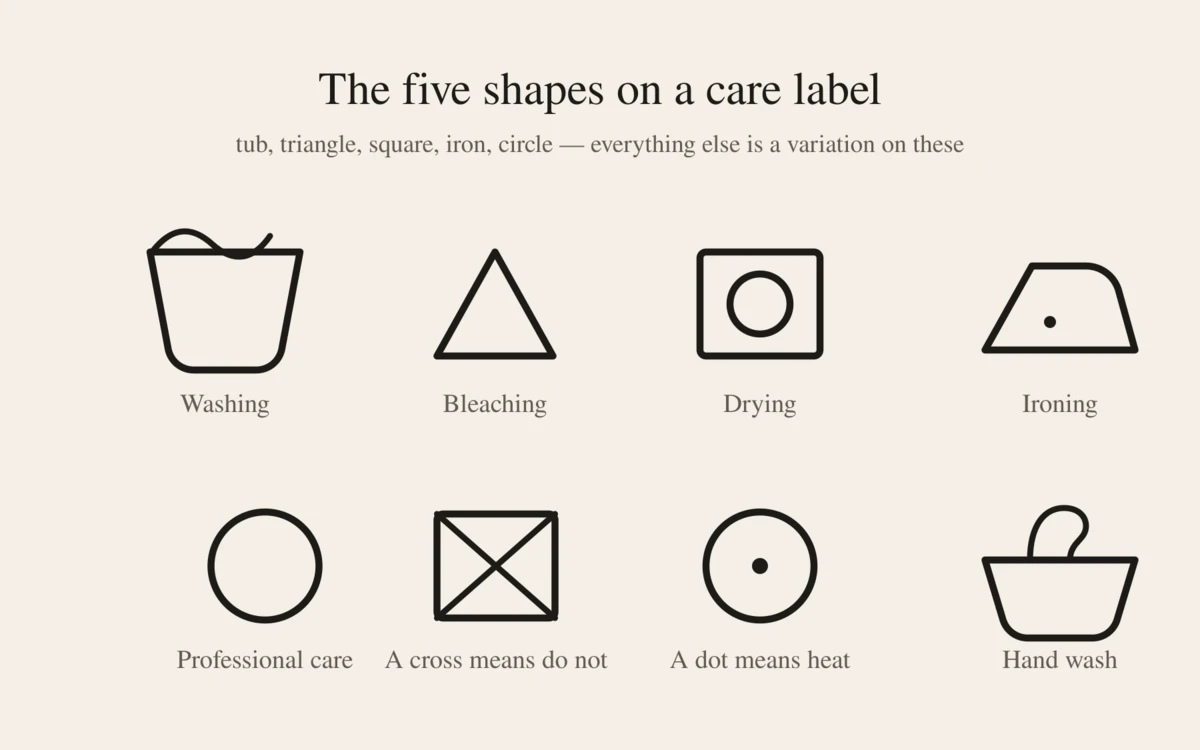
Care symbols are the same across most of the world, and once you know the five basic shapes the rest follows. Each shape covers one process, and what is drawn inside or under it tells you how far you can go. A cross through any symbol means do not do it at all.
The tub — washing
- A number inside is the maximum temperature in degrees Celsius. 30 means 30, not “about 30”.
- A hand in the tub means hand-wash only, in water no warmer than about 40°C.
- One line under the tub means a reduced, gentler cycle. Two lines mean the most delicate cycle your machine has.
- A crossed-out tub means do not wash in water at all. This is where most damage happens: people assume it means “be careful” when it means “take it elsewhere”.
The triangle — bleach
An empty triangle allows bleach. Two diagonal lines inside mean oxygen bleach only, never chlorine. A crossed-out triangle means no bleach of any kind — which covers most wool, silk and anything coloured.
The square — drying
A square with a circle inside is the tumble dryer: one dot is low heat, two dots normal, and a cross means do not tumble dry. A plain square with a horizontal line means dry flat, which is what knitwear needs — hung wet, a sweater stretches and does not come back. A curved line in the top of the square means line-dry; diagonal lines in the corner mean dry in the shade.
The iron
One dot is up to 110°C, suitable for silk and synthetics and best done with a cloth between the iron and the cloth. Two dots are up to 150°C for wool. Three dots are up to 200°C for cotton and linen. Lines under the iron crossed out mean no steam.
The circle — professional cleaning
A letter inside tells the cleaner which solvent to use: P for most, F for a gentler one. You do not need to know which; the cleaner does. A crossed-out circle means it cannot be professionally cleaned, which usually points at a bonded or coated fabric.
Two rules worth more than the symbols
First: wash less. Most clothing is washed far more often than it is dirty. Airing a garment overnight removes the smell of a day, and wool in particular cleans itself with air better than with water.
Second: when the label and your instinct disagree, follow the label. It was written by the people who made the cloth, and it is the one piece of information about the garment that nobody is trying to sell you.